Detailed Description
Connection object holds information about TCP and UDP connections. There is a connection object for each of the following:
- UDP listener
- TCP listener
- TCP connection.
TCP (established) connections are tracked in a Least Recently Used cache. LRU cache is used to check for various timeout conditions. Each TCP connection has a unique Id (connection ID) associated with it. The only purpose of this ID is to provide a unique key for LRU cache. LRU cache implementation uses UT HASH.
Listener connections are not tracked in LRU cache.
UDP listener and TCP connection objects have DNS query objects associated with them.
Data Structures | |
| struct | conn_tcp_s |
| struct | conn_udp_s |
| struct | conn_s |
| struct | conn_fifo_queue_s |
Macros | |
| #define | CONN_IS_UDP_LISTENER(conn) conn->lc == 0 && conn->proto == 0 |
| #define | CONN_IS_TCP_LISTENER(conn) conn->lc == 0 && conn->proto == 1 |
| #define | CONN_IS_TCP_CONN(conn) conn->lc == 1 && conn->proto == 1 |
Typedefs | |
| typedef enum listener_start_error_e | listener_start_error_t |
| typedef enum conn_tcp_state_e | conn_tcp_state_t |
| typedef struct conn_tcp_s | conn_tcp_t |
| typedef struct conn_udp_s | conn_udp_t |
| typedef struct conn_s | conn_t |
| typedef struct conn_fifo_queue_s | conn_fifo_queue_t |
Enumerations | |
| enum | listener_start_error_e { LISTENER_ERR_SOCKET = -1 , LISTENER_ERR_SOCKET_OPT_REUSEADDR = -2 , LISTENER_ERR_SOCKET_OPT_REUSEPORT = -3 , LISTENER_ERR_BIND = -4 , LISTENER_ERR_LISTEN = -5 , LISTENER_ERR_SOCKET_OPT_IP_PKTINFO = -6 , LISTENER_ERR_SOCKET_OPT_IPV6_V6ONLY = -7 , LISTENER_ERR_SOCKET_OPT_IPV6_RECVPKTINFO = -8 , LISTENER_ERR_SOCKET_OPT_RCVBUF = -9 , LISTENER_ERR_SOCKET_OPT_SNDBUF = -10 } |
| enum | conn_tcp_state_e { TCP_CONN_ST_ASSIGN_CONN_ID_ERR = 0 , TCP_CONN_ST_WAIT_FOR_QUERY , TCP_CONN_ST_WAIT_FOR_QUERY_DATA , TCP_CONN_ST_WAIT_FOR_WRITE , TCP_CONN_ST_CLOSED_FOR_READ , TCP_CONN_ST_READ_ERR , TCP_CONN_ST_CLOSED_FOR_WRITE , TCP_CONN_ST_WRITE_ERR , TCP_CONN_ST_QUERY_SIZE_TOOLARGE } |
Macro Definition Documentation
◆ CONN_IS_TCP_CONN
| #define CONN_IS_TCP_CONN | ( | conn | ) | conn->lc == 1 && conn->proto == 1 |
Marco that returns true if conn (conn_t struct) is a TCP connection
◆ CONN_IS_TCP_LISTENER
| #define CONN_IS_TCP_LISTENER | ( | conn | ) | conn->lc == 0 && conn->proto == 1 |
Marco that returns true if conn (conn_t struct) is a TCP listener
◆ CONN_IS_UDP_LISTENER
| #define CONN_IS_UDP_LISTENER | ( | conn | ) | conn->lc == 0 && conn->proto == 0 |
Marco that returns true if conn (conn_t struct) is a UDP listener
Typedef Documentation
◆ conn_fifo_queue_t
| typedef struct conn_fifo_queue_s conn_fifo_queue_t |
Connection object FIFO queue. New objects are enqueued (added) to the tail of the queue, and objects are dequeued (removed) from head of the queue.
◆ conn_t
◆ conn_tcp_state_t
| typedef enum conn_tcp_state_e conn_tcp_state_t |
Enumerated TCP connection states.
◆ conn_tcp_t
| typedef struct conn_tcp_s conn_tcp_t |
Structure holds data specific to TCP listener connection.
◆ conn_udp_t
| typedef struct conn_udp_s conn_udp_t |
Structure holds data specific to UDP listener connection.
◆ listener_start_error_t
| typedef enum listener_start_error_e listener_start_error_t |
Enumerated error returned by listener_start() function.
Enumeration Type Documentation
◆ conn_tcp_state_e
| enum conn_tcp_state_e |
Enumerated TCP connection states.
◆ listener_start_error_e
Enumerated error returned by listener_start() function.
Function Documentation
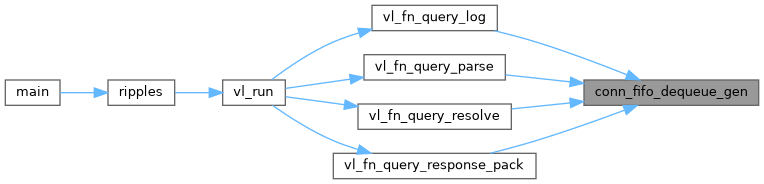
◆ conn_fifo_dequeue_gen()
| conn_t * conn_fifo_dequeue_gen | ( | conn_fifo_queue_t * | queue | ) |
Remove (dequeue) a connection object from generic fifo queue.
- Parameters
-
queue Queue to remove connection object from.
- Returns
- On success returns object, otherwise there are no entries in the queue and returns NULL.
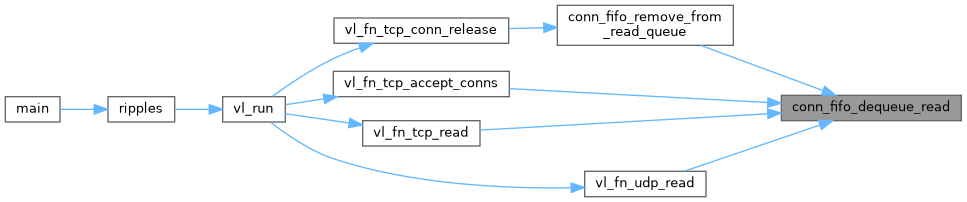
◆ conn_fifo_dequeue_read()
| conn_t * conn_fifo_dequeue_read | ( | conn_fifo_queue_t * | queue | ) |
Remove (dequeue) a connection object from read fifo queue.
- Parameters
-
queue Read queue to remove connection object from.
- Returns
- On success returns connection object, otherwise there are no entries in the queue and returns NULL.
◆ conn_fifo_dequeue_release()
| conn_t * conn_fifo_dequeue_release | ( | conn_fifo_queue_t * | queue | ) |
Remove (dequeue) a generic object from fifo queue.
- Parameters
-
queue Queue to remove connection object from.
- Returns
- On success returns object, otherwise there are no entries in the queue and returns NULL.

◆ conn_fifo_dequeue_write()
| conn_t * conn_fifo_dequeue_write | ( | conn_fifo_queue_t * | queue | ) |
Remove (dequeue) a connection object from write fifo queue.
- Parameters
-
queue Write queue to remove connection object from.
- Returns
- On success returns connection object, otherwise there are no entries in the queue and returns NULL.

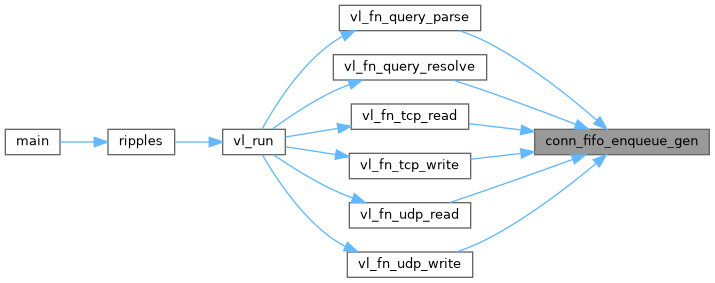
◆ conn_fifo_enqueue_gen()
| void conn_fifo_enqueue_gen | ( | conn_fifo_queue_t * | queue, |
| conn_t * | conn | ||
| ) |
Add (enqueue) a connection object to generic fifo queue.
- Parameters
-
queue Queue to add object to. conn Object to queue up.
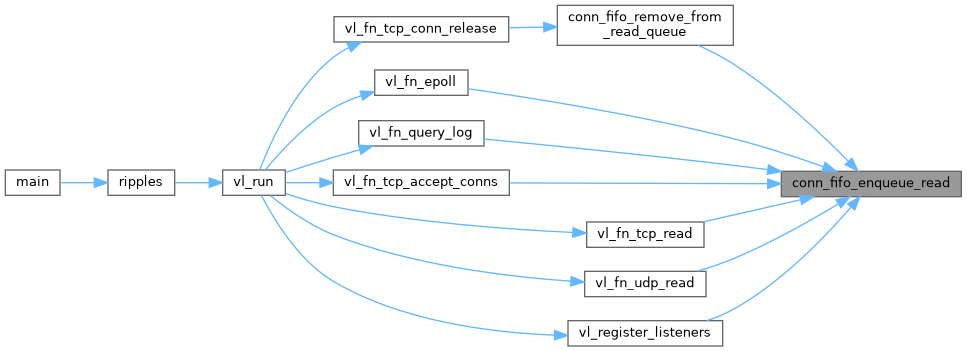
◆ conn_fifo_enqueue_read()
| void conn_fifo_enqueue_read | ( | conn_fifo_queue_t * | queue, |
| conn_t * | conn | ||
| ) |
Add (enqueue) a connection object to read fifo queue.
- Parameters
-
queue Read queue to add connection object to. conn Connection object to queue up.
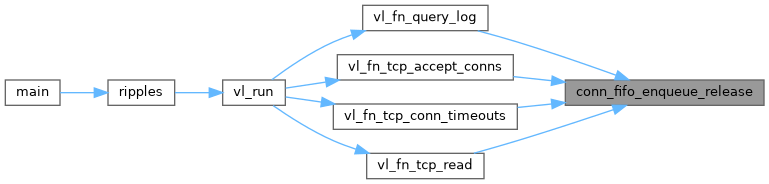
◆ conn_fifo_enqueue_release()
| void conn_fifo_enqueue_release | ( | conn_fifo_queue_t * | queue, |
| conn_t * | conn | ||
| ) |
Add (enqueue) a connection object to release fifo queue.
- Parameters
-
queue Queue to add object to. conn Object to queue up.
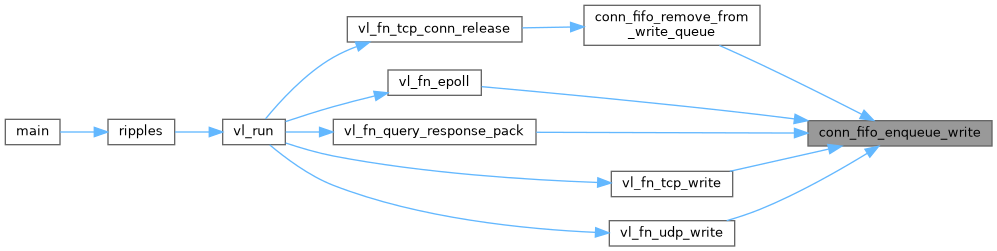
◆ conn_fifo_enqueue_write()
| void conn_fifo_enqueue_write | ( | conn_fifo_queue_t * | queue, |
| conn_t * | conn | ||
| ) |
Add (enqueue) a connection object to write fifo queue.
- Parameters
-
queue Write queue to add connection object to. conn Connection object to queue up.
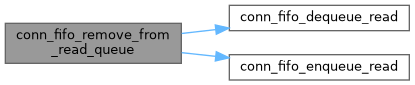
◆ conn_fifo_remove_from_read_queue()
| void conn_fifo_remove_from_read_queue | ( | conn_fifo_queue_t * | queue, |
| conn_t * | conn_rm | ||
| ) |
Remove conn from read queue.
- Parameters
-
queue Read queue to remove conn object from. conn_rm Conn object to remove from queue.

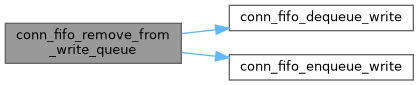
◆ conn_fifo_remove_from_write_queue()
| void conn_fifo_remove_from_write_queue | ( | conn_fifo_queue_t * | queue, |
| conn_t * | conn_rm | ||
| ) |
Remove conn from write queue.
- Parameters
-
queue Write queue to remove conn object from. conn_rm Conn object to remove from queue.

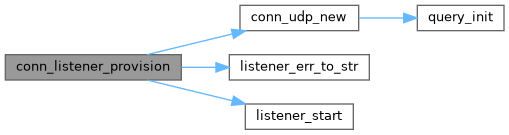
◆ conn_listener_provision()
| conn_t * conn_listener_provision | ( | config_t * | cfg, |
| int | family, | ||
| int | protocol, | ||
| char * | err_buf, | ||
| size_t | err_buf_len | ||
| ) |
Provision a new TCP or UDP listener and return the corresponding connection conn_t object.
Listener is started and associated with new connection object. New connection object is initialized meaning it has all necessary buffers allocated.
- Parameters
-
cfg Configuration object that has settings: - udp_conn_vector_len,
family IP family to start a listener for, valid options are: - AF_INET,
- AF_INET6.
protocol Protocol to start listener for, valid options are: - IPPROTO_TCP,
- IPPROTO_UDP.
err_buf Buffer where to store error message if error was encountered. If NULL no message is stored. err_buf_len Length of error buffer.
- Returns
- On success returns a newly allocated and active connection object. On error returns NULL and message is populated into error buffer.

◆ conn_lru_cache_get()
Get entry in TCP connection LRU cache and also update LRU state (entry is set as MRU).
- Parameters
-
lru Pointer to LRU cache. id Entry key to look for.
- Returns
- On success returns a pointer to connection in LRU cache. Entry place in LRU is updated. Otherwise returns NULL indicating that entry was not found in LRU cache.

◆ conn_new_tcp()
| conn_t * conn_new_tcp | ( | int | fd, |
| config_t * | cfg, | ||
| int | ip_version, | ||
| struct sockaddr_storage * | client_ip, | ||
| struct sockaddr_storage * | local_ip | ||
| ) |
Create a new TCP connection object for an established TCP connection.
- Parameters
-
fd Socket for TCP connection. cfg Application configuration to get various settings from. ip_version IP version this connection is for, 0=IPv4, 1=IPv6. client_ip Client IP address. local_ip Local IP address.
- Returns
- Returns a newly allocated and initialized TCP connection object.


◆ conn_release()
| void conn_release | ( | conn_t * | conn | ) |
Free memory associated with conn_t object and free object it self.
- Parameters
-
conn Connection object to release.


◆ conn_tcp_id_assign()
| bool conn_tcp_id_assign | ( | uint64_t * | id, |
| conn_t ** | lru, | ||
| uint64_t * | base | ||
| ) |
Assign a new TCP connection ID.
- Parameters
-
id Where to store newly assigned TCP connection ID. lru TCP connection LRU cache, used to verify uniqueness of connection ID being assigned. base Base for connection ID. (Base is unique per Vectorloop object.
- Returns
- Returns true if connection ID was assigned, otherwise returns false.

◆ conn_tcp_release()
| void conn_tcp_release | ( | conn_tcp_t * | conn_tcp | ) |
Free memory associated with conn_tcp_t object and free object it self.
- Parameters
-
conn_tcp TCP connection object to release.


◆ conn_tcp_report_metrics()
| void conn_tcp_report_metrics | ( | conn_tcp_t * | conn_tcp, |
| metrics_t * | metrics | ||
| ) |
Report TCP metrics for a query.
- Parameters
-
conn_tcp TCP connection to report metrics for. metrics Metrics object where to report metrics.

◆ conn_udp_new()
| conn_udp_t * conn_udp_new | ( | config_t * | cfg, |
| int | family | ||
| ) |
Create a new UDP connection object
- Parameters
-
cfg Application configuration to get various settings from. family IP family: AF_INET or AF_INET6.
- Returns
- Returns a newly allocated and initialized UDP connection object.


◆ conn_udp_release()
| void conn_udp_release | ( | conn_udp_t * | conn_udp | ) |
Free memory associated with conn_udp_t object and free object it self.
- Parameters
-
conn_udp UDP connection object to release.


◆ conn_udp_vectors_reset()
| void conn_udp_vectors_reset | ( | conn_udp_t * | conn_udp | ) |
Reset UDP connection vectors so the can be reused for next iteration of read/resolve/send of DNS queries.
- Parameters
-
conn_udp UDP connection to reset vectors for.