Detailed Description
Channels are ways of exchanging data between threads. libfsds (Lock Free Data Structures) are used to form channels and exchange transactions or uni-directional messages.
Resource channel(s) are used to notify DNS query processing threads when a resource has changed. Messages are transactional in nature (request-response).
Query log channel is used to notify DNS query aprocessing threads when to flip query log buffers.
Log channel is used to send uni-directional log messages to application logging thread which in turn logs messages to file (disk).
Data Structures | |
| struct | channel_bss_msg_s |
| struct | channel_bss_queue_s |
| struct | channel_bss_s |
| struct | channel_log_msg_s |
| struct | channel_log_s |
Typedefs | |
| typedef enum channel_bss_ops_e | channel_bss_ops_t |
| typedef struct channel_bss_msg_s | channel_bss_msg_t |
| typedef struct channel_bss_queue_s | channel_bss_queue_t |
| typedef struct channel_bss_s | channel_bss_t |
| typedef struct channel_log_msg_s | channel_log_msg_t |
| typedef struct channel_log_s | channel_log_t |
Enumerations | |
| enum | channel_bss_ops_e { CH_OP_RES_SET_RESOURCE1 = 0 , CH_OP_RES_SET_RESOURCE2 , CH_OP_QUERY_LOG_FLIP } |
Functions | |
| channel_bss_msg_t * | channel_bss_msg_create (uint64_t id, channel_bss_ops_t op, void *p) |
| void | channel_bss_msg_release (channel_bss_msg_t *msg) |
| int | channel_bss_send (channel_bss_t *ch, channel_bss_msg_t *msg) |
| int | channel_bss_recv (channel_bss_t *ch, channel_bss_msg_t **msg) |
| int | channel_bssvl_send (channel_bss_t *ch, channel_bss_msg_t *msg) |
| int | channel_bssvl_recv (channel_bss_t *ch, channel_bss_msg_t **msg) |
| uint64_t | channel_bss_assign_msg_id (uint64_t *id_base) |
| channel_log_msg_t * | channel_log_msg_create (uint32_t log_msg_id, char *log_msg, bool exit) |
| void | channel_log_msg_release (channel_log_msg_t *msg) |
| int | channel_log_send (channel_log_t *ch, channel_log_msg_t *msg) |
| int | channel_log_recv (channel_log_t *ch, channel_log_msg_t **msg) |
Typedef Documentation
◆ channel_bss_msg_t
| typedef struct channel_bss_msg_s channel_bss_msg_t |
Structure describes an bss channel message.
◆ channel_bss_ops_t
| typedef enum channel_bss_ops_e channel_bss_ops_t |
Enumerated bss channel operation codes.
◆ channel_bss_queue_t
| typedef struct channel_bss_queue_s channel_bss_queue_t |
Structure describes an bss bonded channel queue.
◆ channel_bss_t
| typedef struct channel_bss_s channel_bss_t |
Structure describes an bss channel, Channel has two queues. Each queue is unidirectional.
◆ channel_log_msg_t
| typedef struct channel_log_msg_s channel_log_msg_t |
Structure describes a log channel message.
◆ channel_log_t
| typedef struct channel_log_s channel_log_t |
Structure describes a log channel.
Enumeration Type Documentation
◆ channel_bss_ops_e
| enum channel_bss_ops_e |
Function Documentation
◆ channel_bss_assign_msg_id()
| uint64_t channel_bss_assign_msg_id | ( | uint64_t * | id_base | ) |
Assign a new channel message ID from given base.
Base is incremented and value returned.
- Parameters
-
id_base
- Returns
- uint64_t

◆ channel_bss_msg_create()
| channel_bss_msg_t * channel_bss_msg_create | ( | uint64_t | id, |
| channel_bss_ops_t | op, | ||
| void * | p | ||
| ) |
Create a bss channel message object.
- Parameters
-
id Message ID op Message operation, see channel_bss_ops_t. p Pointer to data this message applies to.
- Returns
- On success returns pointer to newly created message. Caller is responsible for releasing the message via channel_bss_msg_release once message is no longer needed.

◆ channel_bss_msg_release()
| void channel_bss_msg_release | ( | channel_bss_msg_t * | msg | ) |
Release (free memory) a bss message object.
- Parameters
-
msg Message to release.

◆ channel_bss_recv()
| int channel_bss_recv | ( | channel_bss_t * | ch, |
| channel_bss_msg_t ** | msg | ||
| ) |
Receive a message from support (bss) part of the channel.
This is used by vectorloop threads to receive message from support thread.
- Parameters
-
ch Channel to receive message on. msg Pointer where to place the received message.
- Returns
- On success returns 1, otherwise returns 0. 0 could only be returned if there are no messages in the channel.

◆ channel_bss_send()
| int channel_bss_send | ( | channel_bss_t * | ch, |
| channel_bss_msg_t * | msg | ||
| ) |
Send a message on bss part of the channel.
This is used by support (bss) threads to send message to vectorloop thread.
- Parameters
-
ch Channel to send message on. msg Message to send.
- Returns
- On success returns 1, otherwise returns 0. 0 could only be returned if message could not be enqueued due channel being full.

◆ channel_bssvl_recv()
| int channel_bssvl_recv | ( | channel_bss_t * | ch, |
| channel_bss_msg_t ** | msg | ||
| ) |
Receive a message from vectorloop part of the channel.
This is used by support (bss) thread to receive message from vectorloop thread.
- Parameters
-
ch Channel to receive message on. msg Pointer where to place the received message.
- Returns
- On success returns 1, otherwise returns 0. 0 could only be returned if there are no messages in the channel.

◆ channel_bssvl_send()
| int channel_bssvl_send | ( | channel_bss_t * | ch, |
| channel_bss_msg_t * | msg | ||
| ) |
Send a message on vectorloop part of the channel.
This is used by vectorloop thread to send message to support (bss) thread.
- Parameters
-
ch Channel to send message on. msg Message to send.
- Returns
- On success returns 1, otherwise returns 0. 0 could only be returned if message could not be enqueued due channel being full.

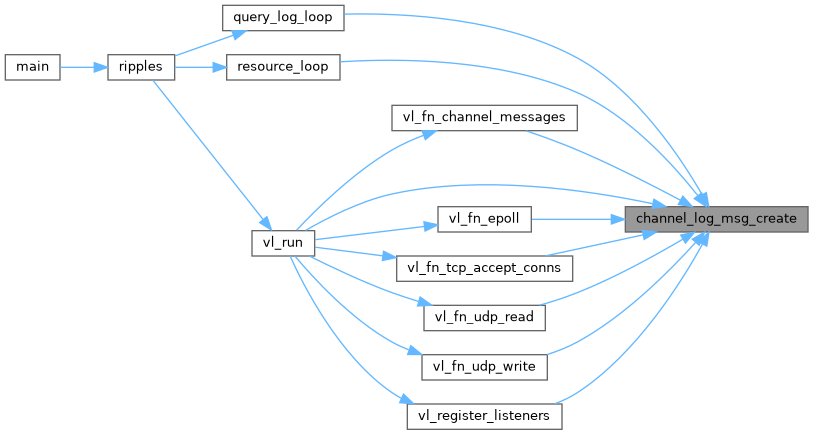
◆ channel_log_msg_create()
| channel_log_msg_t * channel_log_msg_create | ( | uint32_t | log_msg_id, |
| char * | log_msg, | ||
| bool | exit | ||
| ) |
Create a new log channel message object.
- Parameters
-
log_msg_id Log message ID, see app_log_msg_id_t. log_msg Log message string, can be NULL. exit Is this a fatal message, meaning should the application exit once message is logged.
- Returns
- On success returns pointer to newly created message. Caller is responsible for releasing the message via channel_log_msg_release once message is no longer needed.
◆ channel_log_msg_release()
| void channel_log_msg_release | ( | channel_log_msg_t * | msg | ) |
Release (free memory) a log channel message object.
- Parameters
-
msg Message object to release.

◆ channel_log_recv()
| int channel_log_recv | ( | channel_log_t * | ch, |
| channel_log_msg_t ** | msg | ||
| ) |
Receive a message from log channel.
This is used by log thread to receive message from other thread.
- Parameters
-
ch Channel to receive message on. msg Pointer where to place the received message.
- Returns
- On success returns 1, otherwise returns 0. 0 could only be returned if there are no messages in the channel.

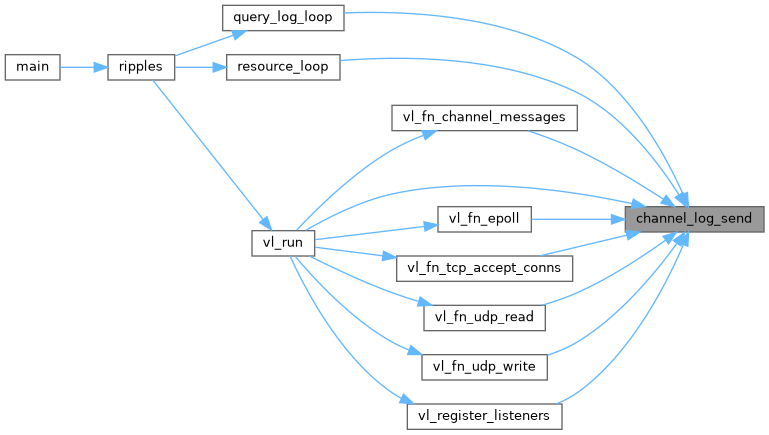
◆ channel_log_send()
| int channel_log_send | ( | channel_log_t * | ch, |
| channel_log_msg_t * | msg | ||
| ) |
Send a message on log channel.
This is used by threads threads to send message to log thread.
- Parameters
-
ch Channel to send message on. msg Message to send.
- Returns
- On success returns 1, otherwise returns 0. 0 could only be returned if message could not be enqueued due channel being full.